Saturday, June 6, 2015

Aurora, Audie and Roman: Enactors and Reenactors

AURORA

Aurora 

Just two weeks ago, I was in Armenia.  On the last day, we visited the impressive Genocide Memorial, chronicling the tragic events of 1915.  As a Jew and old enough to have been alive through most of the Holocaust, the story of Armenian genocide really resonated, even more so because they have never had closure on the systematic slaughter of so many: a Non-Event Perpetrated by Those Who Must Not Be Named. We were rushed through the museum adjacent to the Memorial, and, since it was close to closing time, didn’t get much of a chance to see anything in detail, but I was struck in passing by what looked like some gruesome newsreel footage as awful as a lot of the World War II Nazi films of Jews being slaughtered or packed into boxcars.  Upon inquiry, I was advised to Google “Ravished Armenia.”

I did that later and found this footage on YouTube, but it turned out to be twenty minutes of surviving clips from a now-lost silent Hollywood movie made about the genocide, based on the harrowing memoir of a survivor named Aurora Mardaginian.   Her story is still in print, and online as well.  The latest printed edition, published as Ravished Armenia and the Story of Aurora Mardiginian, (2014), edited and with an introduction by the film historian Anthony Slide and the shooting script of the original film, came out just in time for the Armenian Genocide centennial commemorated this year.

I have read a lot of memoirs of holocaust survivors, and Mardiginian’s story is as gruesome a chronicle as any of them: the systematic murders of entire families, multiple rapes, sexual slavery, wholesale slaughter often preceded by torture, targeting an entire people for extermination, not because of anything they did, but for what they were born into, much as Jews were by the Nazis. 

When Slide interviewed Mardaginian shortly before her death, she revealed to him that she had sanitized the story somewhat—for instance, the death of a group of girls by crucifixion (an irony for nice Christian girls), was actually carried out by impalement on the low crosses through their vaginas.  But Slide’s introduction revealed even more: Aurora didn’t live this nightmare once, but twice, because she played herself in the film version too.

She had arrived in the United States in 1917, with her original name Arshalouys Mardigian, after a long odyssey including her escape to Russian-held territory, passing through Petrograd during the chaos of the October Revolution. She was 14 when her ordeal began, and only 16 when she immigrated. By this time, America was fired up by the plight of the Armenians, and Aurora soon met an American screenwriter, Harvey Gates and his wife who realized her potential for the cause of Armenian relief.  Since she as yet spoke no English, the Gates got her to dictate her story in Armenian, and an interpreter helped them to transcribe it.  The Gates then had it published, and sold the film rights to William Selig.

Aurora was persuaded to go out to California to star as herself, and act as a consultant on the film.  The former U.S. Ambassador to Turkey and an outspoken critic of the Genocide, Henry Morgenthau, also played himself in a brief vignette. 
Aurora (2nd from right) playing herself in the movie, with actors as her family

And so, Ravished Armenia, otherwise known as Auction of Souls, was made and raised millions for the Armenian refugees.  Something of its impact can be gleaned from a press release reproduced by Slide:

“‘RAVISHED ARMENIA’
The story of the girl who survived
Is the greatest motion picture achievement in theme, human interest, seriousness of purpose and thrilling development of dramatic conception ever attempted”


That was the good part.  Aurora had to sue to get the money owed her for the project, and soon returned to New York.  She lived on to marry, have a son and die at age 94 in California, but, given her early experiences, it is not surprising that for the rest of her life she displayed severe symptoms of P.T.S.D., harboring fears that Turks would come to assassinate her in revenge for the memoir and movie. She eventually became a virtual recluse, and died alone, estranged from her son. 

By now, we know well that enduring an experience as she did makes it difficult to survive whole and sane.  I still have scary childhood memories of tattooed Holocaust refugees, wandering around at a Jewish summer resort, who seemed to me at the time to be very weird people.

In Aurora’s case, for all the money raised, it seems beyond my comprehension to have escaped alive, been through such an ordeal, and then have to reenact the whole thing all over again.  Even considering the fact that she was treated well on the set, and it was make-believe (she was even given a romantic interest in the film), was it possible that the reality and the make-believe didn’t merge?  She had to act with American actors portraying family members; actually, she had witnessed many of the real ones’ deaths.  Slide quotes Aurora about her terror of confronting American actors dressed like Turkish forces for the first time.  Later, she broke an ankle during filming, but continued anyway.

Where can we draw the line between reenactment and reality?  Is it ever justifiable to make someone experience such horrors again, even for the sake of charity? 

AUDIE

Audie, 1945, Most Decorated WW II soldier

Aurora was not the only person to play their selves in a movie reenacting traumatic events in their own lives.  In 1955, Audie Murphy, the most decorated soldier of World War II, played himself in the film of the war memoir he had written with David McClure, To Hell and Back. True, by this time, Murphy had been kicking around Hollywood for a number of years, with relatively little success, but in playing himself, he hit pay dirt.

Like Aurora, he had his war experiences behind him by the age of 21, having enlisted in the army at 17, and ten years had passed between his very honorable discharge from the army, and six between the publication of the memoir, and the film, and he was certainly far more savvy about the ways of the film industry.  He had subsequent success as an actor starring in westerns for another twenty, and also was successful as a country-western songwriter.

To Hell and Back had the biggest box office gross until the release of Jaws.  Contemporary critical views have been less kind, the consensus being that it in itself is a period piece: not to World War II, but the way of making war movies in the 1950’s.  Perhaps, because war movies are a genre unto themselves, and because Murphy’s role was proactive, he could avoid confusion between real life and action movie.  He was never a great actor, but his presence in this reenactment gives it an authenticity that an over-the-top recreation by another actor would lack (he allegedly wanted Tony Curtis to play him before accepting the role himself

Audie Murphy plays himself, 1955


Murphy was forthright about his own P.T.S.D. resulting from the war: he slept with a gun under his pillow, became temporarily addicted to sleeping pills and had a hair-trigger temper. However, he was able to benefit from his disabilities and later became an advocate for the recognition of P.T.S.D. as a legitimate condition, unlike Aurora’s promotion as a fundraiser by others.  He died at the relatively young age of 47 in a plane crash.

ROMAN

Roman, 2009

The celebrated film director Roman Polanski, like Aurora, was a Genocide survivor, who had experienced the Holocaust as a child and young teenager in Krakow, Poland, managing to escape during a roundup and then passing as a Catholic Polish child with a sympathetic family.  Like so many survivors, P.T.S.D. would mark him, and the cause was double, with the murder of his pregnant wife, Sharon Tate, by the Manson gang in 1969.  The biography of this talented filmmaker is full of evidence of this, from the brilliant quirkiness of his films (think Repulsion, Rosemary’s Baby, and Chinatown) to the “statutory rape” charge of 1977.

Polanski had been given the opportunity to direct Schindler’s List, but had declined, partly because the action took place in and around Krakow.  He had certainly skirted around Holocaust subjects in the intense psychological drama Death and the Maiden, (1994) though the Fascism here was Latin American.  He finally tacked the Holocaust directly in the superb film The Pianist in 2002.

This movie is someone else’s memoir, Wladyslaw Szpilman, which took place in Warsaw, not Krakow, with the protagonist played by Adrian Brody, though Polanski has had numerous acting roles over his career.  For me, it’s the best Holocaust film ever made, and I invite the reader to read Clive James’s masterful review and analysis of it, available online.

Adrian Brody in "The Pianist"


Roman Polaski on the set of "The pianist"

The parallels and resonances between Polanski’s own experiences in the Holocaust in this film can perhaps be summed up by a statement made by Thomas Kretschmann, who played the sympathetic German officer, Captain Hosenfeld, in an interview with Carlo Cavagna:

“……if you have the chance to meet with Polanski on set, you want to know things. I tried the whole time to get information out of him, out of his own experiences. He was very closed. He didn't talk very much about himself; he didn't talk very much about the scenes. He wanted you to be a part of it, but he didn't want to take the whole thing apart. He just went with you around the corner and played around with the lines a little. Then after the film was done, he opened up. He took me to the first [screening]. Afterwards he says, "This scene happened to me. This scene I watched. This scene…" You get the feeling that the whole thing is packed with stuff out of his own life. But he didn't let you know. I think he didn't want to be distracted. He said all the time, "Concentration is my big passion. I need concentration! I need concentration!"


So The Pianist isn’t a reenactment, but it’s more: the chronicle of two individuals, just guys, faced with the mundane task of day to day survival in an untenable dehumanizing situation: the making of P.T.S.D.

__________________________________________________________

Though the full text of Ravished Armenia can be found online at: http://en.wikisource.org/wiki/Ravished_Armenia

I recommend:
Anthony Slide (ed.), Ravished Armenia and the Story of Aurora Mardiganian, Jackson, University Press of Mississippi Press, 2014.

The preserved footage of Ravished Armenia is at: https://www.youtube.com/watch?v=u3nTw2D07Lk
the film is blurry, the inter titles and music are both modern.

A surprisingly good discussion of the Armenian Genocide is at:
http://en.wikipedia.org/wiki/Armenian_Genocide; it has a great bibliography and good links to other sites.

For a modern discussion of "To Hell and Back, see Matthew Sweet 2009 Guardian review at:
http://www.theguardian.com/film/2009/dec/03/audie-murphy-to-hell-and-back

And Murphy's own promotion when the film came out: https://www.youtube.com/watch?v=wF1F1kRTpWE

Clive James' wonderful on The Pianist is at: http://www.clivejames.com/polanski-pianist

And interviews with both Thomas Kretschmann and Adrien Brody are at:http://www.aboutfilm.com/features/pianist/interview.htm

But you can hear Polanski's take on the film in a bonus interview with the DVD of The Pianist.


Saturday, May 30, 2015

Caucasian sketchy sketches III - Armenia

Armenia: The Gratifying Surprise


(May 16-20): We left Georgia this morning and crossed into Armenia, and into the mountains of the South Caucasus.  It’s beautiful mountain scenery with trees and many rivers, now running very high, but somehow not as awe-inspiring as the northern range.  The landscape gradually lost its trees as we went south, giving way to what looked like green carpet, though it’s actually very stony land, that can’t be farmed.  You’d never know it from a distance though: it looks as if the landscape is entirely covered in golf course turf, and I had the urge to run up one of those hills, though I’m sure would have been much harder than it looked.


Four very high snowy peaks form Mount Aragats, and at the foot of one of the peaks are three Yazidi villages.  These folks are from the same group that was threatened by ISIS in Iraq recently, and there are groups of them in various surrounding countries. .  The have a monotheistic religion that is not Christian, Jewish or Islamic, but developed on its own.  Most of those in Armenia are cowboys or sheepherders.  From there, we descended to the valley where Yerevan is located.  To its southeast, Mount Ararat, but it’s in Turkey, and the border is closed, as is the one to Azerbaijan, because of the Nagorno-Karabakh war.

Mount Aragats 


Armenia is land-locked, with open borders only to Iran and Georgia, and the Iranian borderland is tiny. It is also the least wealthy of the three countries on this trip, with 30% unemployment.  In Soviet days there were a lot of factories that fed into the USSR manufacturing system, but these are now abandoned and derelict.  In most towns,  old Soviet-era apartment buildings and houses predominate, most even shabbier than those in Georgia. Most outside investment now comes from the Armenian diaspora, and there is a long way to go, with the economy so stagnant.

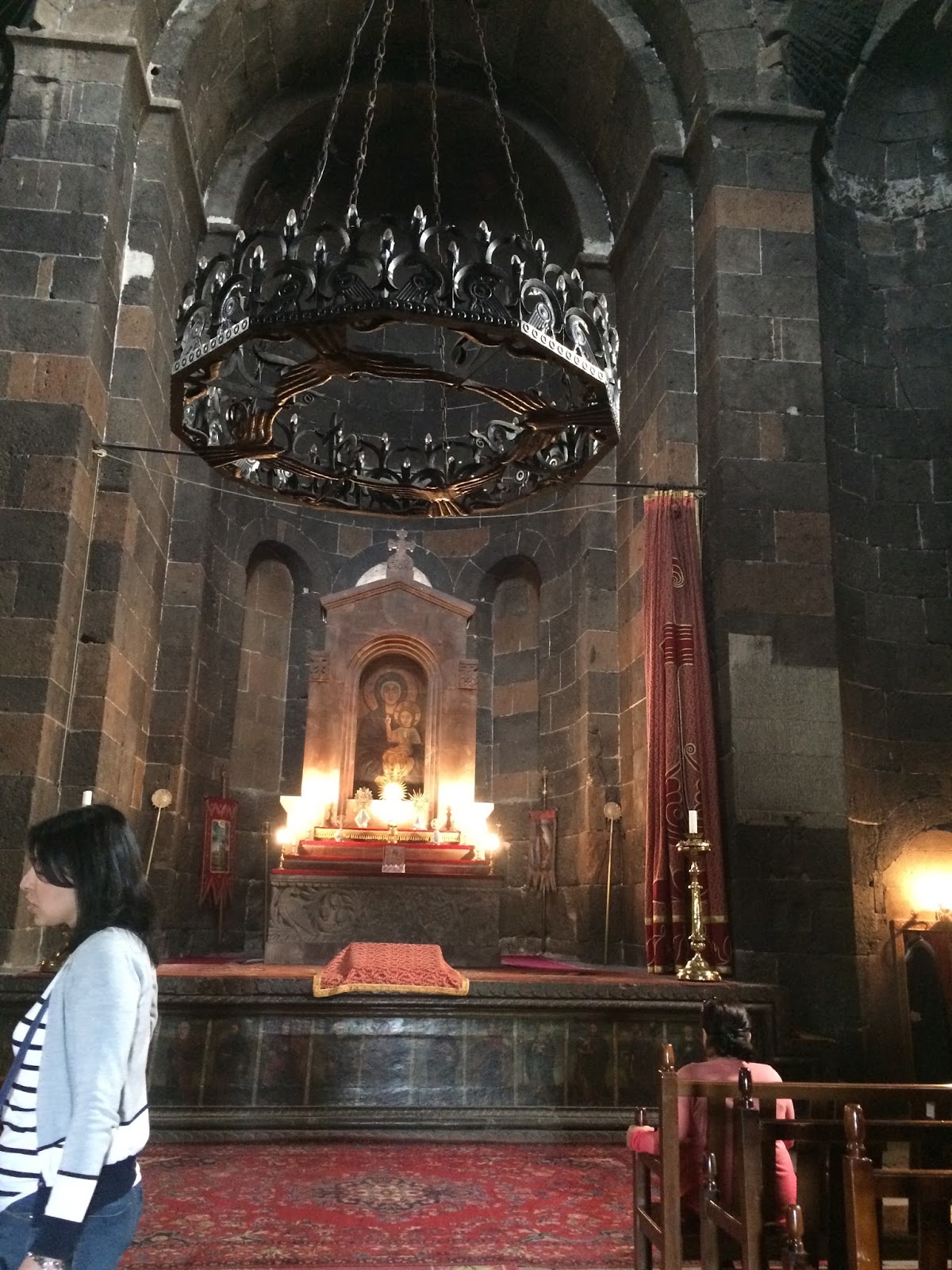
Cozy Church Interior
We visited several Armenian churches and monasteries.  At first they look like Georgian ones, but Armenian national Christianity is even older, and the church interiors are quite different; Most have a covered entry room, supported by four columns, then the main domed sanctuary.  Here there only a very few icons, and no iconostasis, so people coming have a much greater view of the mass itself.  There are curtains that can be drawn over the apse at certain moments.  Surprisingly, these tall dark structures have a cozy comfort.  I guess it has something to do with building proportions, and also the Caucasian carpets that add colorful touches on the floor.

The other great feature in Armenian imagery are its stone crosses, some dating back to its early Christian origins,--and even earlier.  They are elaborately carved in low relief, with profusions of patterns increasing in more recent centuries.  we were reminded of celtic crosses, and for me also, Mayan stelae.
 
Various Crosses at Haghbat Monastery
Urban Yerevan; View from My  Window
Yerevan is the one big city in this small country; Armenia presently is about the size of Maryland, but with floating memories of its golden age during early Christianity. By day the city is somewhat scuzzy: mostly shabby soviet era apartments and ugly construction (with an incongruous San Antonio-style subdivision on the outskirts, built, we were told, by a rich Armenian-American,  and meant as a retirement community for other diasporians who want to live in the Old Country—but in proper comfort). But  the downtown core is a mixture of older nice stuff and some post-soviet construction.  This section has wide streets with a circular loop around city center and a sort of wheel-grid inside, and there are lots of cafes along the streets, as well as one very posh pedestrian shopping street. 


Republic Square on a Saturday Night
In the evenings, though, downtown Yerevan is transformed.  Saturday night, everyone turns out and strolls the streets; folks of all ages, families with tiny kids and older walkers too. There are mimes and buskers everywhere.  Many stores are open late, and there’s enough ice cream being sold to sweeten the kids and adults alike for days. Best of all is the most fabulous musical and colored fountain display in the center. Love is all around.  It’s what an ideal urban experience should be!
Singers at Gerhard Monastery

Gerhard is a particularly impressive monastery, by a gorgeous gorge, on a hillside, partly carved into it. There was a brief concert by 5 ladies who sang acapella in one of the chapels, an unearthly beautiful sound. Later at lunch, we watched ladies make lavash.  It was rolled out, flipped around like a pizza into an oval, put on a big sort of pillow and deposited on the sides of a circular charcoal oven, then pulled off with a hook when ready.  You rip off pieces and fold it around cheese and herbs—wow!
 
Lavash Makers and Their Pillow
We vaguely saw Mt. Ararat, but it was hazy.  Everyone says it looks better from Turkey, but you can’t get there from here.  Most of the time, from Yerevan, one sees one of its two peaks, snowcapped, hovering in the ether, rather like the way Mount Ranier looks from Seattle.  And, by the way, Armenia is over a deep fault line and prone to bad earthquakes.

We drove up to Lake Sevan’ a freshwater lake in northeast Armenia.  We visited 2  ½ more monasteries in the area.  The south part of the Sevan area is hilly, but without much in the way of trees. After going through a tunnel, it’s mountainous and treed—a resort area they like to call “The Armenian Switzerland,” with snowy mountains all around, though in high summer, the snow melts. Locals make summer excursions here when Yerevan is hot, and rich ones have summer houses..

Genocide Memorial
There 60 Armenian-American students from California here for 2 weeks on a heritage tour.  It reminds me of our “March of the Living” trips for young Jews.  The century-old Armenian slaughter is the elephant in the room here, particularly now, since we arrived about three weeks after the centennial of the beginning of that horrifying event.  Posters all over the city commemorated it.  I’m saving a discussion of this for another blogpost.

Our last stop, though, was the Genocide Memorial in Yerevan, which is as moving as Yad Vashem.  The memorial was built in Soviet times (1965), the museum in the 90’s after independence.  The museum has a photographic exhibit, chronological in format and graphic, much like Holocaust museums.  The memorial has a tall, obelisk structure representing a split blade of grass, the shorter piece Armenia, the taller the diaspora. A circle of stones like an interior-leaning Stonehenge surrounds a lower circular area with an eternal flame in its center.  Sad Armenian laments are piped in.  It’s a very meditative space.  Along the pathway in, various groups and families have planted fir trees, with dedicatory plaques beside them in Armenian and whatever home language of the donor.


Both Ararat and Aragats are visible from this high place, but Ararat was hazy again….like an unattainable dream.
Mount Ararat

Thursday, May 28, 2015

Caucasian Sketchy Sketches II:

 Five Rainy Nights in Georgia—As We Go Marching Through


May 11-16, 2015

Over the border to Georgia from Azerbaijan: the landscape is the same, but so different! As soon as frontier is crossed, all the houses are festooned with grapevines.  Towns immediately feel much more European, though Georgian script is completely strange.  

Georgian Feast- Tourist Version
Food and wine seem to dominate everything here.  Our first evening is in Telavi, in the middle of wine country.   Lunches and dinners are vast, and on our first night we were treated to the tourist version of the “Georgian Feast,” replete with singing toastmaster.  The first course is on the table when you come in, and later courses just added on.  The tomato and cucumber salad is still among us, and so are herbs; but also diverse veggies, some stuffed with walnut concoctions in variety, each different. And then there’s katchapuri, an amazing cross between pizza and cheese quiche, in endless   Then comes soup and a meat course, and often potatoes, with or without added veggies, all with sour plum sauce, either green or red.  Some dishes are spicy, some not, but all complexly seasoned, and the table gets more and more loaded.   Great bread baked on a tandoor sort of oven, but it comes out tasting like French or Catalan bread.  All through it, red wine, made in-house and served in pitchers, is consumed, to the tune of many toasts.
subtle and regional variations.

Red wine is called black wine; it’s very dark and full in body, made by fermenting red grapes with stems and skins in buried clay jars for two weeks, then filtered, eventually ending up in oak barrels or other clay sealed jars, the latter buried again until consumed.  White wine is singular in flavor, the best light like Chenin Blanc, the rest stronger in flavor and body.

Towns look different, seemingly less ordered than Azeri ones, and Georgian Christian churches instead of mosques, plus lots of friendly “town dogs” while in Muslim Azerbaijan, almost never.
 
Georgian Town Dog
The landscape in Eastern Georgia is gentle, very agricultural and very green.  The foothills of the Caucasus are green too, and forested.  Mtskheta (you pronounce it!), Georgia’s ancient capital, with fabulous churches and monasteries, sits on a triangular peninsula at the confluence of two rivers of different colors that first co-exist, then merge.
 
Mtskheta of the Two Rivers
Upland, it’s even more  impressive: in Gudairi, we were above the tree line, and the high peaks above us had snow.  Too bad it’s rainy, but it’s awesome anyway, and comparable to the Rockies, but somehow even more majestic, (with different trees, of course)!  But politically, it’s different too.  The Rockies just keep going on, spanning two friendly countries.  The next valley to the west here is South Ossetia, removed from Georgia, along with Abkhazia, further to the west, by the Russians in a war beginning in 2008, but it’s much more complicated than that, as Georgia is a patchwork of ethnic groups and languages, and a turbulent history of various migrations and invasions. I leave the labyrinthine history to specialists, but can say that the Georgian language, like Basque, is not related to anybody else and within itself, has dialects.  It’s hard to get a handle except on a very superficial level, in four days of travel in a country whose language(s) and alphabet(s) you don’t know.

Greater Caucasus, (or what we could see of them)
We came down from the mountains next morning (it was snowing!).  Back down the Georgian Military Highway through the same very green, mountain landscape to the Georgian flats.  We were at Uplistsikhe, with 700 man- made caves that served as a Silk Road caravanserai, parts dating at least back to Byzantine times.  We only got to see a little because of the rain.  Then to ugly Gori, Stalin’s home town and his museum. Outside is the one room in a little house, rented by his parents, where he spent years 0-4, and his green railroad car. So many Stalin portraits! The museum is chock-full of paintings of comrade S.  in the expected social realist propaganda style. He was cutest in an early mug-shot when he was in his teens, then it was all down hill in every way. As a sop, a little room dedicated to his victims in Gori (no mention of the thirty million others). 
 
Stalin  (Youthful Mugshot)
Real Unrestored Caravanserai
And now Tblisi, city of my dreams! My first impression is that it’s a little like Budapest for street vitality, but more raffish and less gloomy, even in the rain.  After further exploration, I think that Tblisi reminds me even more of Barcelona when I first went there in the 1960’s: a little down at the heels, but a Grande Dame nonetheless. Things aren’t over restored yet, so you can see all the wrinkles and cracks.  One mosque, three synagogues (one is now a museum), many Georgian churches, and in the old city, remains of caravanserais and bath houses. Caravanserais went out with the coming of the railroad in the 1870’s, so only remnants remain.Traces of the old ethnic quarters are all there, all next to one another.

You really can’t date structures here. Tblisi was invaded so many times, and so much destroyed and rebuilt.  Different ethnic groups dominated and then shifted. Georgian church imagery is timeless, so that 19th and 20th century icons and paintings look virtually indistinguishable from elderly Byzantine and Russian-type ones. In the old town, streets are narrow and wind around a lot in medieval fashion, though most structures are relatively modern. 

 
Older  (But Fixed-Up) Street in Tblisi
Rustaveli Street, the main elegant shopping street, reminds me of the Passeig de Gracia in 1966, here with modernista buildings replaced by ugly soviet era ones.  There isn’t much industry here, so I think the city gets by on its raffish charm to attract tourism, at least for now.  But we are staying in a cubic Holiday Inn with all conveniences.

On our last day last day in Tblisi, we went to a museum full of icons and other relics, medieval to 19th century after a nice talk by a Georgian art historian on cloisonné, an old art form here from early times until the 15th century.  It is being revived now in exquisite jewelry (I bought some later on in the day).  We saw earlier examples in the museum.  For me as an art historian it was very nice, though as usual, there was not enough time to really examine things, read the labels, and make comparisons. We couldn’t go to the other museum that we had planned to because Rustaveli Avenue, and the museum itself was closed because of a big trade conference here.

Georgian Christianity is the second oldest national one in the world, with its own liturgy.  We were taken to many historic churches and monesteries all around the eastern part of the country.  They are mostly high and dark, and do remind me of Eastern Orthodox ones that I have seen in Russia and Jordan, with an iconostasis and a large amount of icons ultimately following Byzantine examples, so that it’s hard stylistically or iconographically to tell a very old one from a newer one.

The Jewish community traces its roots back to the Babylon Captivity, and, some maintain, possibly the tribe of Issachar.  In recent years many of them have emigrated to Israel, but there are still 13,000 left, who have always lived peacefully among everyone else.  The Akhaltische synagogue is really gorgeous, and well maintained (it was built in 1904). The little Jewish Museum, located in a former synagogue, had the usual ceremonial stuff, Georgian-Jewish bridal costumes, and a very early (11th c., I think) tanakh with micrographic borders said to have been brought to Jews in Georgia by an angel!  In the basement, they were preparing an exhibition by a contemporary Jewish embroiderer that opens Monday; too bad that we’ll be gone.  Building wise, the old Jewish quarter is pretty shabby, but maybe it’s because 30,000 Georgian Jews emigrated during Soviet times. The Georgian Jews are proud that there’s never been anti-semitism in their 2600 year old history here; though Soviet domination was nasty to any religion.
 
Alkhaltische Synagogue, Tblisi
I would love to know my City of Dreams better, and know what really makes it tick, but I’m too old to learn its complicated language and alphabet, much less its dialects and linguistic soup of other languages.  I guess I’ll have to be satisfied with Catalonia.

Tbilisi postscript: at the top of one of the hills surrounding Tblisi is a small amusement park with a Ferris wheel that is outlined in ethereal light blue at night. Except that the lights in the spokes of one quadrant don’t work.  Perfect summation of this town!
Tblisi with the Ferris Wheel On The Hill (and also cellphone tower)