Tuesday, June 11, 2019

Miserables III: Movie and Mini

           There have been so many movies, television productions and Miniseries retelling Les Misérables, that I have lost count.  They include myriad versions in from Japan, as well as Turkey, Egypt, Germany, Italy, Mexico and Spain, not to mention the numerous French and English ones, going all the way back to the Lumière Brothers in 1897, just twelve years after Victor Hugo's death.
A poster for a 1912 film version of Les Misérablesdirected by Alfred Capellani


            I will give some internet resources for analyses of these various versions at the end of this post.  For myself, I just wanted to discuss two: the very latest television production from the BBC of 2018, now being streamed on PBS in America, and the French film directed by Raymond Bertrand of 1934. Both are exemplary for me in the retelling of Hugo's massive novel with limited, but expanded time frames (6 hours for the miniseries, nearly 5 hours for the movie).  It's a pity that the 1925 French silent version isn't readily available--it ran about 7 hours and used to be shown over two days.

            Though there have been numerous films made of the novel since Bertrand's black and white classic, I don't think that any of them measure up.  Lack of color (still in its infancy) is no problem.  The superb cinematography (including hand-held cameras for the barricade sequences), expressionistic lighting and a moody score by Arthur Honegger all syncronize beautifully with Bertrand's direction.  The casting too is perfect.  Harry Baur, I think, comes closest to my own literary impression of Jean Valjean. He is not young, even at the beginning, heavyset, definitely a peasant tree-trimmer, not at all attractive, with hair that whitens during the film as per Hugo's description, but so expressive and eventually so likeable in his plainness!  I find the process of his redemption, not by overacting, but by restraint, not only believable but increasingly sympathetic as the film progresses. 
Harry Bauer and Charles Vanel: Les Misérables, 1934

            The same can be said of Charles Vanel who plays Javert--he too is massive, often monolithic, and his looming inflexibility makes his presence a heavy adversary in each scene he is in. This film introduces him in a low-key first scene in which he appears as one more figure in the Prison system, where he simply reminds Valjean as he leaves prison of the consequences of recidivism. Only later, in the role of the police chief at Monfermeil, does he take up his adversarial relationship with Valjean aka Mayor Madeleine.  When he appears at the dying Fantine's bedside, he seems to fill up all available space in monolithic menace.  While not quite Hugo's gorilla-man, he comes very close. Homely, like Baur, the two men really portray two men of humble beginnings, and their conflicting growth as poles of inflexibility on the one hand and the possibility of redemption on the other.

            The rest of the cast is wonderful too.  I wish I had space to discuss them all, but you can check them out on IMDB.  The film does a splendid job of both complex character portrayal and staying close to many incidents in Hugo's novel.  A few of the book's key narratives are cut:  there is no second imprisonment of Valjean, and once he rescues Cosette from the Thenardiers' clutches, the tale fast-forwards to Cosette's 16th birthday--no time at the Gorbeau house, no pursuit then by Javert and escape and time at the convent.  Likewise, the Thenardier parents disappear after they get arrested in their extortion manouvers--there is never an encounter with him by Valjean and Marius in the sewers, and no subsequent blackmail attempt.

            The ending is simplified too: the day after Valjean frees Javert at the barricades, the policeman arrests him as he emerges with Marius from the sewer, allows Valjean to take Marius to his grandfather's house--where Valjean identifies himself as the young man's rescuer, and all is quickly resolved, including Javert's suicide.

            The episodes that are included, though, are rendered in meticulous detail.  Fantine's brief romance and tragic decline and fall are rendered beautifully.  The actress Forelle portrays Fantine in a way that recalls Hugo's character: blonde, fragile, and a little feckless. The scriptwriters choose to show the beginning of her seduction, then fast-forwards to her working at M. Madeleine's bead factory. Her descent from poor-but-fastidious mother to toothless prostitute is carefully but quickly shown. It's really M. Madeleine's remorseful care that restores her spiritual respectability. When he goes to liberate Cosette, we not only feel the child's gratitude, but the emotion of human tenderness that begins to grow within her rescuer.

            Likewise, the entire sequence of Thenardier and his cronies' attempted robbery of Valjean, Marius's dilemma as a witness, Javert's raid on the robbery and Valjean's escape is tightly edited and very exciting.  And Orane Demazis's Éponine is so different from the sexpot waif of the musical! She's a little chunky, a little cheeky, and very much a street girl, as is Émile Genevois, who plays her brother Gavroche, the supreme urchin (he, ironically, later had a bit part as an omnibus driver in the 1958 French remake of Les Misérables).

            Most splendid of all is the barricade sequence, from its initiation during Lamarq's funeral procession to the total defeat and slaughter of the student rebels, including the execution of Enjolras and Grantaire. The drama escalates in tension and violence, some of it filmed by hand-held camera as if it was actually happening, to the heroic, futile last stand of the remaining protestors, with time to narrate Éponine's and Gavroche's deaths, and Valjean's liberation of Javert.

            It's this examination of Jean Valjean's transformation, and Javert's corresponding inability to live beyond his own rigidly set parameters that makes this film so effective, and it's done without any histrionics, over-acting or excessively corny emotionalism.  This film is hard to find, and doesn't stream anywhere--you have to by the remastered DVD.  It's worth seeking it out.

            The 2018 miniseries has even longer to tell the story, and, as directed by Tom Shankland and written by Andrew Davies, earnestly attempts to cram as much of Hugo's novel as can be done in its six hours. Hugo is not strictly chronological: the Battle of Waterloo occurs midway through the novel.  In the BBC series it is, of course vastly compressed, but it does set the stage for both the stories of Thenardier and Marius Pontmercy and the political problems of his family. In this way, it pays tribute to Hugo's historical digression, but sums it up by visual spectacle and that all-important last paragraph.

            Not only is a good deal of the novel's content in the series, but some embellishments are added: Fantine's fall is very much expanded and drawn out, with an emphasis on an almost operatic-like pathos, including her consignment of Cosette to the Thenardiers, and focusses on her sacrifice of her teeth and hair in agonizing detail.  Lily Collins, who portrays Fantine has dark hair and is model-slender, quite different from the blond, vulnerable innocence conveyed by Forelle. There is also an added incident depicting the Thenadier's eviction from their inn by Javert's men to transition them from lower middle-class to Parisian petty extortionist criminals.  

Dominic West, Lily Collins, Mailow Defoy and David Oyelowo: Les Misérables 2018
            The two opposing characters are played by very handsome and charismatic actors.  Oyelowo's Javert is portrayed as acknowledging Valjean's challenge to his narrow definition of good and evil and its non-changeability from the very beginning.  It begins while Valjean is serving his 19 years, first when Javert witnesses Valjean's loosening of stone and then saving a chain-gang guard's life at the stone quarry (this episode is not in Hugo's work, instead Valjean is shown supporting a falling caryatid on a building so it can be repaired--and this figures in the 1934 film), and a subsequent altercation in which both Valjean and Javert establish their respective points of view.  The latter is more or less in the musical, but not in the novel.  

            What overwhelmingly dominates the 2018 production is this epic opposition the two main protagonists  The executive producer of the miniseries is David Oyelowo, who plays Javert to Dominic West's Jean Valjean, and I wonder if this is why he is a more dominant and forceful presence here.  In Hugo's novel Javert is indeed Valjean's bloodhound-like pursuer, but so much of this pursuit has to do with the coincidences of where fate places the two protagonists.  Indeed, in Hugo's novel, when he finally corners Valjean and Marius at the sewer exit he's actually there in pursuit of Thernadier as a corpse robber of the sewers.

            In the BBC production, Javert becomes so obsessed with capturing Valjean that he prioritizes above helping to quell the 1832 uprising, his primary duty as a police chief.  He goes to the barricade in disguise because he believes that Valjean will show up there, not really to spy on the student rebels.  Another problem is that these two characters never age over the period from 1815 to 1832.  Hugo has Valjean's hair turn white after his rescue of Cosette.  Dominic West is slender and fit right up to the end; he's well into his 60's according to Hugo at his time of death, and here his hair finally, in the last scene, is gently frosted gray.  Javert, no spring chicken either, is unchanging not only in his philosophy but in appearance.  He looks exactly the same right up to his suicide.

            When these two characters are on the screen, they dominate it, and the others seem paler in comparison, though many of them are impressive on their own when they have the chance.  Marius and his contentious relationship with his grandfather is examined in detail--indeed more even than in the book, for the miniseries has Marius' visit to his dying father much earlier in his life, and is able to talk to him, while in the novel he never does meet him when he's alive, and Marius only discovers the truth about his heroism when he's grown up. But the aristocratic Guillernormand's character, similar in a way to Valjean, begins to see things in a very different way by the time he consents to Marius's and Cosette's marriage.

            One of the more appealing qualities in the miniseries is the examination of the extended Thenardier family and their changing dynamics. We are shown the love for Mme. Thenardier for her two daughters, even as everyone disintegrates as their circumstances fall, and her confession that she loves her daughters, but not her son.  Both Éponine and Gavroche are portrayed as intelligent and resourceful; Éponine is not a sex-kitten any more than her 1934 counterpart, she's somewhat more blatant in her sexuality, even turning up as a whore in a brothel scene, but unlike Fantine she dabbles in this as just another source of income. Much like the 1934 film, the deaths of both at the barricades comes off as tragic and touching:  they are heroic in their deeds, but will disappear without a trace or a memory when everything settles down again.  I wish the scriptwriters had made the relationship of the two youngest Thenardier boys with the rest of the family clearer.  In the novel they are literally rented out so early that Gavroche, when he adopts them and trains them in the arts of urchinship, doesn't even know that they are his brothers.  The very last scene in episode 6, when the other Thenardiers are dead or scattered, shows the two boys begging in the street, an eloquent reminder of the miseries of the underclass after the uprising.  The screenwriters used them as symbols of the futility, but, in their own words, didn't associate them with the Thenardiers.
The Original cover for the Classics Illustrated Comic: 1943

            In the conscientious way that the series unfolds--in a literal sequence of storytelling with various episodes unfolding by intercutting them, in the gorgeous costumes and strong acting, and with so many of the novel's details put in, including Valjean's second imprisonment (though not his manner of escape), and the harrowing pursuit of Valjean and Cosette by Javert's men averted by that tense climb over the convent wall, I commend this production.  But for evoking the spirit of Hugo's novel in a human way--even with abridgements--I find that Raymond Bertrand's 1934 film, with its homely Valjean and Javert does it better and touches my heart more deeply.

P.S.: Les Misérables just keeps going in many media.  If you have little time to read thenovel or slog through five or six hours of film or Television, you can read the Classic Comics version.  It came out originally in 1943, but has been republished with a new cover in 2015.  It costs $9.95 on Amazon, but you can download Hugo's massive novel for free.

________________________________________________________________________

You can download Hugo's complete novel in Isabel Hapgood's 1887 translation (with illustrations) athttps://www.gutenberg.org/files/135/135-h/135-h.htm

Two short retrospective reviews of the 1934 production can be found at:


A nice visual analysis of several of the other films is from a new blog  "Infrequentmusings":https://www.youtube.com/watch?v=UtGJX0JCqFk film comparisons


Sunday, May 12, 2019

Miserable Ones - Part 2: Hugo set to Music


          The musical adaptation of Victor Hugo's novel opened in its English version in London in 1985, and is the second-longest running musical ever (only exceeded by the New York run of the Fantasticks, which lasted 42 years).  It will go on hiatus during the fall of 2019 while its theater is renovated, but will start right up again in December.  The original French version extends the record back to 1980.

            Les Misérables is not the first work by Hugo to be translated to the musical stage. Hugo himself adapted The Hunchback of Notre Dame into an opera version in 1836, with music by Louise Bertin.  He changed the title to La Esmeralda, focused more on the gypsy dancer than the hunchback, and gave it a happy ending.  The opera was a monumental flop and soon forgotten.  Hugo also wrote plays, and several were adapted into splendid and successful operas, the two best-known with music by Verdi: Hernani(which became Ernani)and the ever-popularRigoletto, taken from Le Roi se Amuse, with the location and philandering nobleman changed from France to Italy to avoid censorship. 

            "Les Miz," with its enduring Cosette logo, taken from the illustration in Hugo's 1862 publication, is known all over the world.  It was originally conceived by Alain Boubil (book) and Claude-Michel Schönberg (music) as a French "concept-musical" in 1980, and successfully staged in Paris the same year, though for a limited run.  The English-language version was produced by Cameron Macintosh, with its libretto written by Herbert Kretzmer, and subsequently expanded further, keeping about a third of the French book in translation, while most of the musical numbers were retained, though modified. Additional scenes, songs and a prologue were added. There have also been cuts over the years, and restorations too, but the basic structure of the show is retained.  

            Numerous websites give particulars about both the French and English versions, and both are available in full on you-tube.  I recommend the complete symphonic recording for the English score, though it has to be streamed in segments.  The Mackintosh production has been translated and produced in many languages--full performances in Spanish and German can also be found on You Tube.

            The internet contains a veritable avalanche of blogs and other websites on all aspects of Hugo's novel, the musical, and films. After so much hype and reviews, reactions and commentaries, what more is to be said?  Here is some of this writer's own very personal reflections on how well the show conveys the plot and sometimes the essence of the novel.

            The musical Les Miserables takes the major incidents of Hugo's sprawling book, dispenses with the digressions, and of necessity with the change in art form, tells the its story through successive episodes, beginning with Valjean's release from his 19-year prison sentence, following many, but not all, of the fits and starts of his journey, and ends with his death in spiritual peace.  The entire score is sung, opera-style, complete with recitatives à la Mozart or Rossini, to give many details to advance the plot.  Many of its tunes are repeated in the way of Wagnerian leitmotifs, by different characters with different lyrics.  The result is a coherent and dramatic whole manages to convey the spirit of Hugo's novel. That said, it's not a classic opera. Many of its songs are not arias but French Euro-pop melodies characteristic of the 1980's; some of its numbers evoke earlier prototypes: "Do You Hear The People Sing" is a modern Marseillaise, here used with some irony, since the uprising of 1832 was in reality pretty small. On the other hand, it still resonates: I heard it this morning on the radio in connection with an ongoing Filipino election campaign.  "Master of the House" evokes The Threepenny Opera(particularly, not surprisingly, in the German production).

            It's a theatrical necessity that the antithetical characters of Valjean and Javert be established at the beginning, at the time of Valjean's release from his sentence even though, in the novel, Javert doesn't recognize Valjean-the-criminal until he frees Fauchelevant from the overturned cart in M-sur-M.  On the other hand, in no musical version is Gavroche identified as a member of the Thernadier family.  As a matter of fact, Alain Boubil was inspired to conceive Les Misérables as a musical after he had seen a London production of Oliver, and was inspired by the character of the Artful Dodger as an inspiration for Hugo's urchin.  In the musical, Gavroche is a sort of stand-alone symbol of all of the street-orphans of 19th-century Paris.

            In the musical, it's the women become the most misérable. Éponine, who had been such a pampered child, becomes a street-waif as her family fails and moves to Paris.  The musical omits her sister Azelma altogether. Éponine suffers from unrequited love of Marius, which allows the writer and composers to cast her as the tragic girl, and this sets her up for some terrific belted-out torch-songs (her part in "In My Life" and her solos "On My Own" and "A Little Drop of Rain.")

            Fantine is the other victim, aware of what she's lost in "I Dreamed a Dream," and the tour-de-force narration in a single song of the chronicle of her fall ("Lovely Lady,") and her dying lament (which shares a melody with Éponine's "On My Own."

            Each of the major characters gets at least one solo-soliloquy that really defines them.  Valjean has the most, as appropriate for the principal hero.  Most serve not only to define his personality but alto further the story ("What Have I Done,?," "Who Am I?," while "Bring Him Home" is an emotional ballad showing his humanity. Javert declares his personal morality in "Stars," and the final negation of it in the song before his suicide, which invokes portions of "Stars," but more importantly also the melody from Valjean's "What Have I done," effectively contrasting the start of one journey and the end of another.

            All the digressive essays and so many of the novel's incidents are cut, both because of theatrical expediency, such as the incident where the fleeing Valjean and Cosette escape vertically from a blind alley, or for the sake of time (Valjean's second imprisonment). There are other scenes which encapsulate a lot of action into small timeframes that really work: for me this includes "Lovely Ladies," mentioned above, "Master of the House," particularly when the long introduction is retained, as it manages to compress the Battle of Waterloo into one line; and "One Day More," in which so many of the story lines, melodies and characters converge, to set up the rest of the plotline.

            The epic scene at the barricades provides spectators with the big pile of street and domestic objects that make up the street blockage.  The audience shares the space of the insurrectionists.  The militia enemy is never seen, but the ominous fanfare that precedes
A real barricade in Paris: a daguerrotype from 1848
each attack makes their menacing presence felt.  So much of the story takes place in this space: the deaths of both Éponine and Gavroche, Javert's capture by the rebels and his release by Valjean and the battle itself ending with a tableau of the slaughtered insurrectionists, as well as Valjean entering the sewers with the wounded Marius.  Even the song during a lull in the action, "Drink With Me," a personal favorite, combines black humor, bravado, and regrets, defining the personalities of diverse student participants. The futility of the uprising is first reflected in ambitious productions by having the barricade set revolve to its front side, to reveal the tableau of defeat and death, or in more modest ones simply presenting it by the way the actors fall on the fixed barricade set. then reflected by women collecting the participant's bodies ("Turning") and Marius's lament of survivor's guilt ("Empty Chairs with Empty Tables").

            And then, there's the sewer scene with its eerie music that adds to its spooky, dark, sinister atmosphere.

            I don't want to go on listing all the songs and how they function; others have done that.  I just think that in the end, the musical play works very well in capturing the spirit of Hugo's novel, and I'm intrigued at how many theatrical conventions are used throughout the show. These include recitative, tableaux, traditional solos, and even an apotheosis, when all of the dead protagonists join Fantine as Valjean's moral muse, to see the redeemed old hero out.

            A quick word on the 2012 film of the musical: it is good, perhaps better than most movie adaptations of Broadway/London theatrical productions.  Some of the cuts from later productions of the stage show (including the explanatory prologue to "Master of the House") happen here too.  On the other hand, the flexibility of filmed episodeso allow for a staging of the blind alley scene, though it's not particularly dramatic.  A better addition is the actual building of the barricade, with people throwing furniture out of windows, and the staging of both sides of the street battle.

            Casting in the film, though be better: Much as I like them both as actors, Russel Crowe is an opaque, thuggish Javert, while for me, Hugh Jackman is a far too youthful and attractive choice for Jean Valjean.  Colm Wilkinson, whom I saw in the New York production, really incarnated Valjean for me--and though he played the Bishop in the movie, Jean Valjean he will always remain.  The Thernadiers of Helena Bonham-Carter and Sacha Baron Cohen were very funny, but in their burlesquing never showed the darker side of the couple.  That may be partially in the nature of the musical comedy tradition, but the late Leo Burmeister managed to juggle both in the Broadway production.

            The musical version of Les Misérableshad been the vehicle keeping Hugo's epic tale alive during the last decades of the 20th century and the first of the 21th.  And it's still going: If anybody in San Antonio reads this, yet another traveling production will be here Sept 17-22, 2019 and you can get another dose.  That is, if you haven't deserted it for Hamilton.

My Very Own Sweatshirt, bought in New York in 1987

_________________________________________________________________________

Wikipedia has a good article on the Musicals: https://en.wikipedia.org/wiki/Les_Misérables_(musical)

The complete English symphonic production, with no cuts is available at:
(note that this is a link to the first segment.  You then have to play each successive one)

The original French Concept (with stills from the show) version is at: 

A list of songs and their correspondences in the French and English versions, though incomplete and in need of checking and revision: https://en.wikipedia.org/wiki/Songs_from_Les_Misérables

Erin Kahn's thoughtful analysis of the differences between some texts in the French and English versions:http://woodbtwntheworlds.blogspot.com/2014/08/les-miserables-original-french-concept.html

The whole German Version, performed in Duisberg, in 1999, though somewhat blurry:
https://www.youtube.com/watch?v=Pisu16FmCxY (German-Duisberg 1999)

The Whole Spanish Version, Performed in 2011 in Madrid streams at:https://www.youtube.com/watch?v=vBf0pGatTvw


Saturday, May 4, 2019

Miserables: Good Bad and Ugly, Part 1


"Fantine," by Margaret Bernardine Hall (1886)
           
            In 1986, some friends who had been spending time in England raved about a new musical based on Victor Hugo's Les Misérables.  When an American production was announced the following year, I asked my father if he could get us tickets for the next time we visited him and my mom in New York. The tickets were ridiculously expensive and almost impossible, but my Dad promised that if I read the Victor Hugo novel--complete and unabridged--he would get some.  Well, I did and he did.

            It was a good thing that our visit was months off, because Hugo's epic, over 1500 pages in the 1887 Hapgood English translation, took a long time to read.  In the manner of some 19th-century novels (think War and Peace, for example), spanning a number of years, it has a large cast of characters, and spends a lot of time ruminating about them and their thoughts and habits.  When you're done, you really know these fictional people in depth.  The author divides his epic into 5 volumes, each subdivided into books, and these in turn into chapters. Each has its own title. Embedded in the novel are tangential essays on topics such as the Battle of Waterloo (more than 60 pages long), a meditation on convents (50 pages +), street urchins, Parisian street slang, barricades and how to build them, and a tour and history of Paris's sewers. 

            For the modern reader, it's a slog.  Imagine, in the middle of a contemporary epic thriller, time out for a 50-page discussion of the D-Day invasion, merely because one of the character's uncles participated in it and a result had PTSD, which subsequently made it hard on his family, but only tangentially on the character herself?

"The Escalade"
            When the action moves along, the narration is riveting, for example when Valjean and Cosette, pursued by Javert and trapped in a blind alley, manage to escape in the dark by scaling a very tall wall, this being accomplished by skills that Valjean learned as a criminal, and helped in no small way by his phenomenal stamina and strength.  It was tense drama when I first read it, and remains so now on a second reading, even when I know how it turns out. 

            What most impresses me is that the principal characters in Hugo's novel, though very much embedded in their 19th-century world, are timeless, and they resonate in us to this day. Human nature, both positive and negative, transcends time.  This is hard-wiring.

            The two main antagonists, Jean Valjean and Javert are the most complex, and Hugo, by exploring their backstories, helps define this complexity.  Some critics have suggested that in some ways these two men are very similar, but it seems to this reader that they are polar opposites in the way they cope with the traumas and events in their lives.

            Valjean comes from a modest rural family.  When he commits what would now be considered a misdemeanor, he is sentenced to the galleys for a five-year prison term--not uncommon back then.  By the early 19th-century, criminals serving in galleys were no longer slave rowers. Many of them were physically housed on prison hulks by the city of Toulon, Tikkun Olam, "The Repair of the World."  The process is slow, and at first he robs a boy of some money almost as a knee-jerk throwback to his prison life, but the rest of this massive novel chronicles his journey.
Jean Valjean as Mayor Madeleine
and brought onshore to do chain-gang labor.  Because of several escape attempts, Valjean's prison term stretched out to nineteen years. Hugo endows Jean Valjean with prodigious strength, but he is at first an anti-hero, and even later, never a superhero, but a conflicted and human one.  On his release after 19 years, he must have been suffering from PTSD, not a condition known about back then, and at that moment anger at the society and system that incarcerated him.  It takes the saintliness of Bishop Myriel, who not only gifts him materially, but who instills in him an isotope of trust and faith, to begin his metamorphosis into humanity and a desire to practice what Jewish belief calls

            Hugo makes it clear that Valjean's own consciousness in his quest for self-redemption that when he surfaces in the town of "M sur M" and heroically rescues children from a fire, he  assumes the name "Father Madeleine," certainly an identification with that premier Christian example of redemption, Mary Magdalen. He thrives there (including using his great strength to rescue a man from under a collapsed cart), and uses his wealth derived from the Bishop's silver to help the town become prosperous, eventually having his own jet bead factory and being elected Mayor. But he is still learning the ropes, defining morality too narrowly, and dismissing Fantine from his factory because she has lied about her illegitimate child. Later, when he tries to help her--too late--he begins to understand that human nature is seldom black and white, nor are the vagaries of living.  It is then when his confrontation with his nemesis, the police inspector of his town, truly sets him on his own redemptive path, which will grow in him even through another, briefer prison term, from which he escapes, leaving him technically once again a fugitive.

Javert
            I wonder if it is the fact that Valjean had a normal life and familial connections for 27 years before he stole that bread helped in the recuperation of his humanity.  Is it this lack of a normal childhood that will determine the path of Inspector Javert?  According to Hugo's description of him, Javert's features somewhat resemble a gorilla, and we never learn his first name.  Hugo gives him a grim past: he is born within prison walls, his mother a fortune teller, his father a criminal.  He is like Valjean in a fierce desire to better himself, but with no real childhood or family life, there's no underlying foundation of humanity.  He will always see things strictly by his definition of lawful morality in black and white.  Upholding the law is his one and only anchor to direct him out of the prison ambiance, which makes him a rigid

fundamentalist. He sees right and wrong as exclusive opposites.  If you are in the wrong you can never be trusted because you can never rise above evil. It reminds me of some politicians now who cross off the eligibility of a candidate because he smoked a joint when he was 16.

            When Javert formally meets Valjean as Mayor Madeleine when he becomes police chief in M sur M, he instinctively recognizes him as a formal criminal, though it takes him time to narrow his former identity down to Jean Valgean who he observed as a on the chain gang 16 years previously. When in the end Valjean spares his life at the barricades, this glimpse of the possibility of change rips away his absolute, rule-bound anchor, and his life becomes meaningless; suicide is the only solution.

Mr. & Mrs. Thernadier
            Other principal characters in the novel also still resonate, though they are less nuanced.  Fantine, too innocent at first and too trusting of her lover (whom we could equate to a fraternity-boy stereotype), is an example of a good person making bad judgements.  She becomes a victim of the sex trade after leaving her daughter with strangers.  The Thernadier parents are scoundrels, rapacious and amoral.  They keep turning up like bad pennies, leaving train wrecks behind them.   Cosette also begins as a victim; I am surprised that her experience as Cinderella among the Thernadiers leaves her relatively unscathed--is Valjean's rescue and unconditional love timely enough to restore her innocence? And Marius, that privileged boy who manages to escape his monarchist, ultra-conservative grandfather's thumb, goes to the barricades not for any political ideal, but because he thinks he can't have the girl he loves?

            Those of us old enough to have lived through the student unrest of the late 1960's can certainly identify with the ill-fated students from the ABC tavern and their abortive revolution.  Enjolras is one of those pure political idealists who lives and dies for his ideology--but, like Javert, is completely lacking in compassion for the working poor he thinks he represents.  These are the same upper middle-class young men as the fraternity boys who play around with Fantine and her friends, though youthful idealism sets them apart. 

            The street people we meet, especially two of the five Thenardier offspring, can find their echo in poor kids of any working people's neighborhood, though contemporary American society is more marginally fluid than that of France of the 1830's. Éponine and Gavroche have no way out, once they are dragged from lower middle-class marginal
Marius Conforting the Dying Éponine
respectability to the urban streets, and their parents join the underworld of Paris.  These are intelligent children with initiative, and Éponine is the only female protagonist in the novel with who is independent-minded and mistress of her own fate, but at that time, there was really nowhere for her to go, and her attachment for the refined Marius is doomed from the start.  Maybe if she lived in the United States in Hugo's time she might have grown up to be a tough pioneer, or if she had lived a little later, Calamity Jane.

            I'm afraid this is a very superficial look at a very dense and complex novel.  I am no literary critic.  I have written these thoughts only to provide a basis for my next entry, which will deal with thoughts on Les Misérablesas it has resonated in some its retelling in various media in the 19th and 20th centuries.

            The best thing is to read the whole epic for yourselves. It is available uncut in the Hapgood translation online, and you can download the whole thing. It also includes the Gustave Brion illustrations for the original French publication of the novel in 1862. I will forgive you if you speed-read through or skip the Battle of Waterloo.
__________________________________________________________________________The project Gutenberg address for the Hapgood translation of Hugo's Les Miserables is at:http://www.gutenberg.org/files/135/135-h/135-h.htm

For an excellent synopsis and a lot of incidental information, see the Wikipedia entry:  https://en.wikipedia.org/wiki/Les_Misérables
(an even more detailed synopsis can be found at the French Wikipedia site)

A plethora of 19th-century illustrations for the novel by various illustrators (and the source for the ones I use here) can be seen at:https://www.mtholyoke.edu/courses/rschwart/hist255s13/images/illustrations/page/image1.html


Saturday, February 2, 2019

When Horror and Violence Are Expressed With Subtlety: Ramón Casas i Carbó Part III

The [Cavalry] Charge (1899/1902)
Ramon Casas, The Charge, Olot, Museu de la Garrotxa

Of the three paintings by Ramon Casas dealing with contemporary violence, La Carga(The [Cavalry] Charge is by far the largest--it's nearly 9 feet wide by 6 feet high.  This panorama depicts the charge of mounted members of the Civil Guard breaking up a labor demonstration.  The scenario takes place in non-specific plaza in Barcelona, against a backdrop of a church and smoky factories.  A vast crowd of workers, escaping the charging police rushes towards the rear of the plaza. while a smaller group of laborers are being driven back in the foreground at the extreme right. Right next to the latter are two clearly defined figures: an isolated worker who has fallen, with a mounted policeman with a sword and flying cape, appearing to be ready to trample him.  The rest of the intervening space in the plaza, occupying about two thirds of the surface, is empty except for the indistinct blob of another fallen figure close to the fleeing crowd.  Almost all the color in the picture both in the setting and the figures, is in bleak, dusty neutrals.  The only exceptions to this are in the black suit and white cuffs of the fallen man, and the black and white uniforms of the police, with one brilliant accent of the scarlet of their neck cloths.

Even more than in Casas' Garrote Vil, it is the startling emptiness of all of that open space--here like the eye of a hurricane, that makes the peripheral violence so intense.

By 1899, when Casas did this painting, Barcelona had been suffering not only anarchist bombings but a great deal of labor unrest, the largest being the May Day strike of 1890.  This sort of labor unrest was certainly not confined to Barcelona, or Spain: The Homestead strike of steelworkers against Andrew Carnegie was occurring in the U.S. at the same time (1892).  In Barcelona, another general strike would take place in 1902, and they would continue to occur all over Europe and the United States well into the 20th century.

Emanuel Leutze: Washington Crossing
the Delaware,New York Metropolitan Museum
But Casas himself declared that this painting did not reference a specific event.  It was rather done as a modern equivalent to the noble tradition of "History Painting:" large-scale works that commemorated historical events, normally designated for public spaces.  Goya's large 2nd of May, 1808, painted in 1814 (along with the more celebrated3rd of May), was Washington Crossing the Delaware(1851) --you get the idea.  The main difference here is that this a dramatic scene of a familiar realistic event that could have happened--but not technically one of a single incident.
likewise proposed by the painter as a commemorative history painting; and so certainly is Samuel Leutze's 

Casas: "Noi de Toma"
Art historians have pointed out that the plaza landscape encompasses a conflation of landmarks--the apparent church is a side view of Santa Maria del Mar, while the factories were located in the Poble Sec neighborhood, a significant distance away.  Is there some irony in that these two locales were basically the real venues in Casas' other two paintings of violence (Santa Maria del Mar for the Corpus painting, the factory smokestacks visible in ?  Various scholars have also pointed out that the fallen figure of the worker was modeled in Casas' studio; he was a well-known local character dubbed "Noi de Toma" (real name Josep Molera), and that Casas used his sketch of him in a cartoon for the magazine Pel i Ploma, showing a drunk man falling of the end of a tram.  The face of the policeman was also used by Casas for a cover illustration of the same magazine, but here his eyes are open.
Garrote Vil

Carmen Lord, in her study of Ramon Casas, chronicles the lack of success of the original composition in the painting's rejection by the Spanish jury for submissions to the Paris Exposition Universelle in 1900.  But the painting did eventually gain success--Casas made some modifications to the painting (including evidently the shift of the policeman's gaze from straight ahead (as it appeared in Pel i Ploma) to looking down towards the fallen man.  He also gave it a more specific title: Barcelona, 1902!! -- maybe making it a more "real" history painting, since that was when that second violent general strike in Barcelona happened.  He exhibited it at the Exposition Nationale des Beaux-Arts in Paris in 1903 to rave reviews--and references in the Catalan media marked its relevance to the strike of 1902.

Ramon Casas, Charles Deering 
Charles Deering, the American Farm Machinery magnate and art collector, saw the painting in 1904 when it was shown in Madrid, and was duly impressed--he made pains to meet the artist, and they subsequently became close friends, traveling together in Europe and America, and Casas eventually became associated Deering in his project to restore an old hospital in Sitges into a subsequent personal residence.  Deering remained so impressed with The Charge, that he asked Casas to make a copy for him in 1911.  Casas replied that he never made replicas of his own work, but would do a second different version for him.  This painting, now in a private collection in Florida has the civil guards, this time on foot, in pursuit of a fleeing crowd of peasants.  The setting this time is specific, the Plaça Mercadal in the town of Vic (it still exists and has a fabulous Saturday market).  As is the case with Garrote Vil, Casas did a study without people of the site in preparation.  But once more, this scene is a made-up event not a real one.  The atmosphere is much darker--even rainy, the void between the peasants and the police is far less dramatic, and the coloring is much duller
Ramon Casas: The Charge II, Florida, Private Collection
--the police still have their red bandannas, but it is much more muted.  Although Isabel Coll Mirabent, in her book on Deering and Casas praises the work for its subtle technique, the overall impression for this writer is one of dreariness, more like chasing a herd of bison seen from the rear than a panicked crowd of humanity.

Attempted Assassination of Alfonso XII
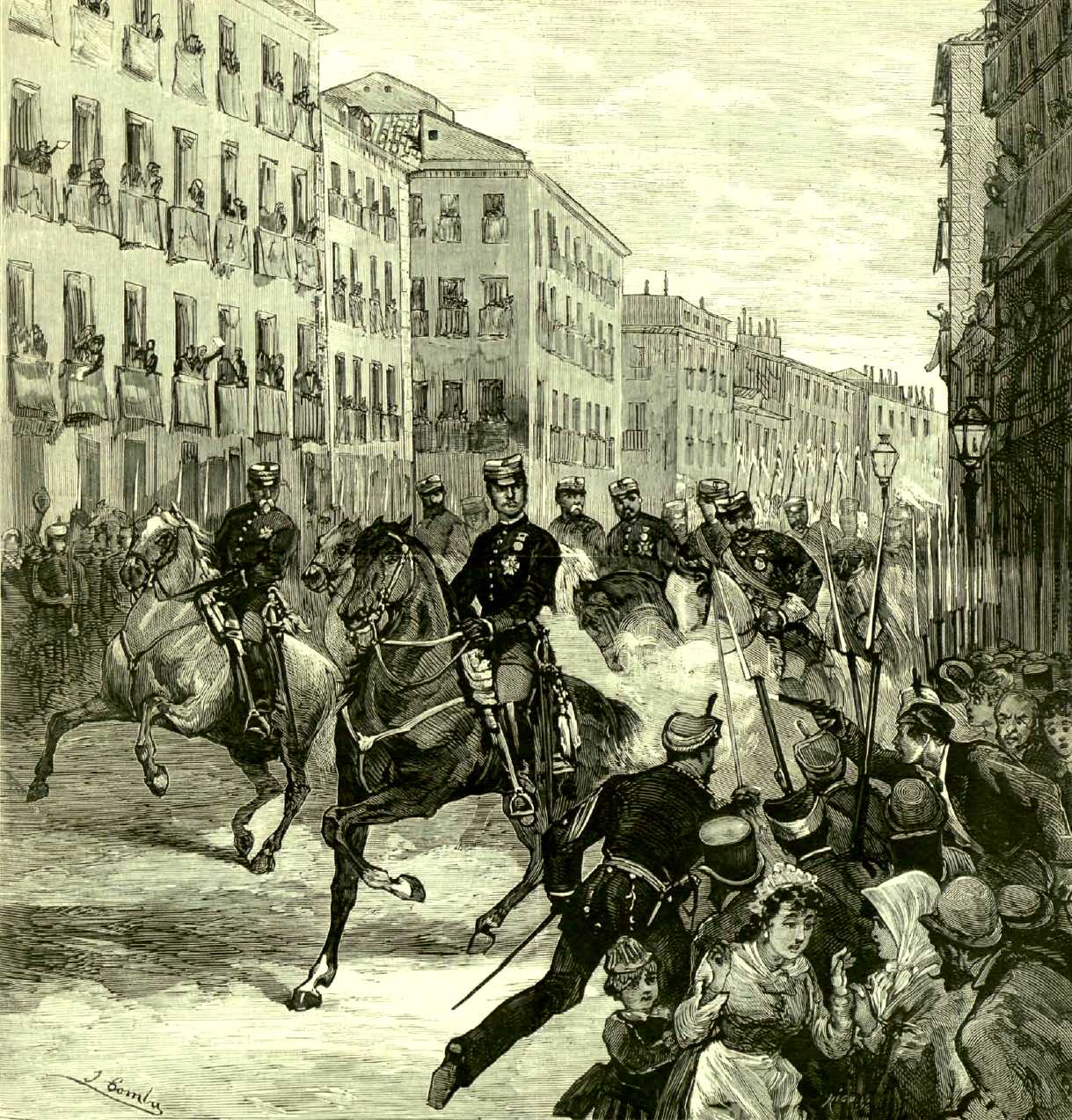
Though non-specific (at least in its original conception), the original Chargeis dynamic and effectively represents a scene of a type that many residents would have been familiar with.  It's Casas' only real painting in which overt violence plays a part. This is fitting for the painter's one venture into a monumental "History Painting,"  but, like Garrote Vil and it's the implication--in this case that big void, that makes it so compelling, and a great drama, rather than a big group of fallen, bloody bodies or a large group of horsemen coming directly at you as seen in popular engravings of the period, such as the one showing an anarchist's attempted assassination of King Alfonso XII in 1878.
Corpus,

One final note: there is an excellent short film on the three violence paintings of Ramon Casas that visits the actual sites that Casas used, and goes into a great amount of detail, but, for English-speaking readers, has the disadvantage of being in Catalan.  I provide the link below:

____________________________________________________________________________


Carmen Lord, Point and Counterpoint: Ramon Casas in Paris and Barcelona1866-1908.  This is her doctoral dissertation from the University of Michigan (1995) available online through Proquest. 

Isabel Coll Mirabent, Charles Deering and Ramon Casas.  A Friendship in Art, Evanston, IL., Northwestern University Press, 2012.

For the excellent Video about Casas and the violence paintings (in Catalan) see:https://www.ccma.cat/tv3/alacarta/programa/La-carrega-de-Ramon-Casas/video/4272010/

On the 1890 General Strike:https://www.encyclopedia.com/history/encyclopedias-almanacs-transcripts-and-maps/general-strike-spain

Friday, February 1, 2019

When Horror and Violence Are Expressed With Subtlety: Ramón Casas i Carbó -- Part II

Corpus: Exit of The Corpus Christi Procession Leaving Santa Maria del Mar
Ramon Casas,Corpus,: Exit of the Corpus Christi Procession Leaving Santa Maria del Mar, Barcelona, MNAC

This painting by Ramón Casas was exhibited at the at the IV Exhibition of Fine Arts and Artistic Industries at the Palace of Fine Arts in Barcelona.  It won a gold medal, and was immediately purchased for Barcelona's Municipal Museum, and is now in the Museu Nacional d'Art de Catalunya. 

It depicts a festive scene of the Corpus Christi procession leaving Barcelona's iconic church of Santa Maria del Mar.  Part of the procession is already out of the picture, but a marcher is visible carrying a banner at center left, with other members of the parade leaving to go up the street in front of him.  Behind, the rest of the parade waits to depart at the church door.  This is a group of mostly secular marchers and a bevy of young girls in white, who have just taken their first communion.  In the foreground at right, is a group of spectators seen from behind.  Other viewers stand at left, while more merge to the right with the departing paraders, and even more can be seen from the multi-hued bunting-decorated balconies in the background. Mounted police in festive uniforms make space for the parade.  

Everybody is milling around the festive scene. Though there are patches of empty street here as in Garrote Vil, here they wind diagonally as a river, adding to the composition's rhythm Though most of the coloring is neutral grays, blacks and whites, there are accents of bright color. A group of turquoise-uniformed officials, as well as colored hats among the spectators, the bright bunting and the red blouse of a mother with her chubby daughter who views the parade from the extreme right, as well as the billowing plumes of the policemen lend an air of pleasant excitement.  In Casas' usual technique, a few details are picked out, but the rest is an impressionistic freely brushed-on composition.  The faces of the little girls are pink blobs among their white veils.

This painting could pass as simply a slice of late 19th-century Barcelona life.  The Corpus Christi processions in Barcelona and other Catalan towns were famous, and besides the
Arcadi Mas i Fontevila, Corpus Christi Procession,
Sitges, Maricel Museum
religious procession, there were other secular events that accompanied it.  A similar depiction of the Corpus festival in Sitges, way before invention of the famous flower carpets, was done by Arcadi Mas i Fondevila in 1888.

But there is a far more sinister agenda to Casas' painting, because by the time he completed and exhibited it, Barcelona's Corpus Christi Procession had been suspended for two years. That's because the 1896 parade was blasted by a terrorist bomb, as it was returning to its church.  Six people were killed, including two children, and over forty injured.  
The Corpus Bombing: Contemporary Engraving

During the 1890's, Barcelona had experienced not only labor unrest, but a series of bombings carried out by Anarchists.  Two had occurred in 1893, one targeting a general, the other the bourgeoisie as they were attending an opera at the Liceu Theater.  In the first two cases, the perpetrators were speedily arrested and executed, the first by a firing squad at the prison at Montjüic, the second, the Liceu bomber Santiago Salvador, publicly by garrote at the Pati dels Corders. 

Corpus Christi Parade, 2016
The official reaction to this third bombing was itself violent.  The actual deed was committed by a French anarchist, but the government decided to crack down on local Anarchists too: arrests, imprisonments, five executions by firing squad and deportations followed.  Labor Setmana Tràgica(Tragic Week) in 1909.  The Corpus Christi festival would not resume until the Franco regime reinstated it in 1941 (it continues today in a more contemporary form in both Barcelona and Sitges, as well as other towns).
unrest, anarchism and uprisings would continue in Barcelona, culminating in the

Carmen Lord's study of Ramon Cases includes several preparatory sketches, so he certainly had this painting in mind for a time beforehand, much as he had for Garrote Vil.  But what is interesting is that he makes some deliberate artistic choices that depart from the actual event:  To begin with, the bombing took place at nine in the evening, and the painting certainly implies a full daylight hour.  In addition, the actual procession began at Barcelona's Cathedral, and after winding through neighborhood streets, ended at Santa María del Mar, rather than heading out from it.  The bombing actually took place on the street approaching the church (Carrer dels Canvis Nous) to its right, and here the procession appears to be heading off to the left (Carrer de l'Argenteria).

But artistic notwithstanding, in Casas' painting, the facade of Santa Maria del Mar is readily identifiable, and to spectators at the exhibition this painting would have had immediate associations, and understood the subtlety of its message.

Southerland Springs First Baptist Church
on an ordinary Sunday
To contemporary viewers, not knowing the backstory, the tragic implications associated with this festive scene would be lost, but this device of a tranquil preface to a violent act is still one used particularly in film and television, to this day.  How many "Coming Soon" previews have we seen where the initial scene of happy ordinary lives is quickly blasted by some violent event?  If someone were to do a pictorial scene of such an event today, it might be of the parishioners of the First Baptist Church of Sutherland Springs, Texas serenely going to Sunday services at around 10:30 on November 5, 2017, half an hour before Devin Patrick entered it with his arsenal of death.

There is a Part III.  It will be posted soon.
________________________________________________________________________


Carmen Lord, Point and Counterpoint: Ramon Casas in Paris and Barcelona,1866-1908.  This is her doctoral dissertation from the University of Michigan (1995) available online through Proquest. 

An historical analysis of the Corpus Christi bombing can be found at an excerpt from Temma Kaplin. Red City, Blue Period: Social Movements in Picasso's Barcelona. Berkeley:  University of California Press,  c1992:

The photo of the present-day Corpus Christi procession is by Margaret Coad, and is at: