Wednesday, June 22, 2016

POLIN: Time Travel is Here!

 
POLIN: Museum of the History of Polish Jews
            Museums can mean and have meant many things, but I guess that the most general definition of it in contemporary terms would be, as the Encyclopedia Britannica puts it: “institutions that preserve and interpret the material evidence of the human race, human activity, and the natural world.”  Many are open to public view, and can exhibit everything from art to dinosaur bones, fire engines, famous baseball players or chocolate.  One that has recently opened in Warsaw, Poland (2013) completely blew my mind: POLIN, the Museum of the History of Polish Jews.  I made a one-day trip to Warsaw from Berlin a couple of weeks ago (it takes less time to fly between those cities than between Dallas and San Antonio), and spent my whole day there.  I should have gone for two and stayed over.

            The museum is very large and beautifully designed, and totally integrated into the digital age.  It is more than just a collection of artifacts, rather it is a journey, through digital magic, through a thousand years of Jewish history in Poland, and the core exhibition is laid out as a sort of directed maze through which you wander through time, with all kinds of mixed media evoking and explaining the historical trip, and simply gathers you in.
Map of the Core Exhibition Space


Tower of San Martín, Teruel
            I first became aware of it through an interest in vernacular architecture, especially two regional groupings of specific types of buildings made with inexpensive materials.  In each case, the building and certainly a lot of the architectural painted decoration was done by Muslims or Jews, both of whom shunned human representation. The building techniques were those of all kinds of buildings in their respective regions. One is a group of medieval churches in Aragon, Spain, built mainly in brick and ceramics in the 14th to 16th centuries, mostly by Muslim workmen with local materials.  Many of these survive, and their gorgeous decorations are undergoing thoughtful restoration.  The other was a group of wooden synagogues, built mostly in the 17th and 18th centuries by Christian and Jewish carpenters, in present-day Poland, Lithuania and the Ukraine, likewise beautiful and distinctive designs in wood, many of their interiors lavishly decorated with painted wildlife, plants and words.  None of these survive.  Many simply deteriorated over time, as Jewish populations dwindled or shifted; those that remained were destroyed during World War II—Nazi casualties along with the populations that attended them.
 
The Wooden Synagogue of Zabludow
            Fortunately, those that made it to 1939 were documented by Polish photographers, and in 1957, the Architects Maria and Kazimierz Piechotka published a wonderful book of many of the surviving ones, republished as Heaven’s Gates in English in 2003, reproducing the photographs and presenting plans and drawings too.  I was able to get the English edition a number of years ago in Krakow, and now it has been reissued as a paperback, but so far as I know, only available at the museum.  Also in 2003, an American architect, Thomas Hubka published a superb detailed study of just one of these buildings, entitled Resplendent Synagogue, dealing with the one at Gwozdziec.

Maria and Kazimierz Piechotka
            Hubka’s text was in inspiration.  It was decided to reconstruct the painted interior and exterior of the ceiling of the Gwozdziec synagogue as the centerpiece of the new Warsaw Jewish museum. The job was given to Handhouse studio in Massachusetts, under reconstruction specialists Rick and Laura Brown, who are neither Polish nor Jewish, but quite a number of the students from several  different countries participating in the project were. There were also Polish millennials who had never met real live Jews before.  They researched materials and construction methods, as well as the sort of paints used in the originals.  In 2013, their ceiling as well as the gazebo-like bimah (Torah-reading platform) was installed in the new museum as its centerpiece.

            It was to see that reconstruction that was my primary reason for making the trip, with a secondary one that my grandfather came from Poland (Brzeziny) and had spent time in Warsaw as well, before seeking better opportunities, first in England and finally the U.S.  The museum gave all my grandfather’s stories that I had heard in childhood context, and helped me understand the American Immigrant experience that shaped my parents as well. 

The Old Country, 1920's: No Thanks!
            Everything I had heard about the Old Country had sounded negative: poverty, ignorance and prejudice. The photos I had seen of impoverished Jewish towns, or shtetls, Fiddler on the Roof not withstanding, made it seem awful.  I was glad to be an American, and glad that my grandparents had come here, beyond the fact that if they had lingered behind, they would have been wiped out.  A trip  to Krakow several years back had been charming, but the pilgrimage to Auschwitz nearby pretty much convinced me to vow never to revisit Poland or anything Polish again. The discovery of the wooden synagogues book made me think that maybe there was something more, and the Museum changed everything.

Isidor Kaufman: Rabbi in Jablonow Synagogue
            To visit the core exhibition, you go downstairs and enter the labyrinth, beginning in the 14th century, when traveling Jews in the area were asked to leave their weapons at the synagogue door before entering (so resonant now)!  Winding through tentative beginnings—life for Jews, with no homeland to go to and no military clout was always dicey, since they were allowed in at the whim of the places they meandered through—into their gradual settling down both in cities and small towns. It was a precarious journey, but they managed to survive, into a short golden age in the 17th century under the relatively permissive Council of the Five Lands (four in Poland and one in Lithuania), when they had some autonomy.  They managed reasonably well (except for a rampaging Cossack massacre in 1648), mostly under direct protection of the Aristocracy, who employed them.  They kept their distinctive dress, customs, and regional jargon (later to evolve into Yiddish), and also to the professions to which they were restricted.  The grandest of the wooden synagogues were built then, and the Gwozdziec reconstruction takes pride of place in the museum as a symbol of that era. 

The Gwozdziec Reconstruction
The Gwozdziec original ceiling

            The museum beautifully evokes those times via models, artifacts, maps and recreated sounds (though mercifully no smells).  The visitor is channeled into ever-changing spaces, each devoted to a different aspect of daily life and larger religious and cultural events; lighting levels, spotlighting, and even the colors of the spaces evoking or explaining different topics.  Some rooms are large, such as the one with a model of 17th century Krakow; some are almost niches or nooks.  Drawers can be opened, revealing objects of significance.  For later times, there are photographs, newspapers and film footage.  In each room or gallery niche, the visitor is encouraged to look for and read texts and examine pictures and things that suddenly bring everything to a personal level.

            As the history becomes turbulent again, through Poland’s own tragic partitions and the waxing and waning of anti-Semitism from without and sectarian conflict from within, the spaces wind in on themselves. Marking the beginning of the secularism of the “Enlightenment,” they become somewhat more rectangular.  With the Yiddish literary movement, paralleling so many of the linguistic revivals of diverse ethnic European minorities at that time, I enter into more familiar territory: this was the culture of my grandparents.  Along with it came labor movements and protests, and for the first time, prominent participation by women.  It also explains the strong Socialist and Communist leanings of many American Jewish immigrants then (and residually, Bernie Sanders, who is from my generation). Unsaid but always present is the thought of where that culture might have gone if it hadn’t been so abruptly extinguished.
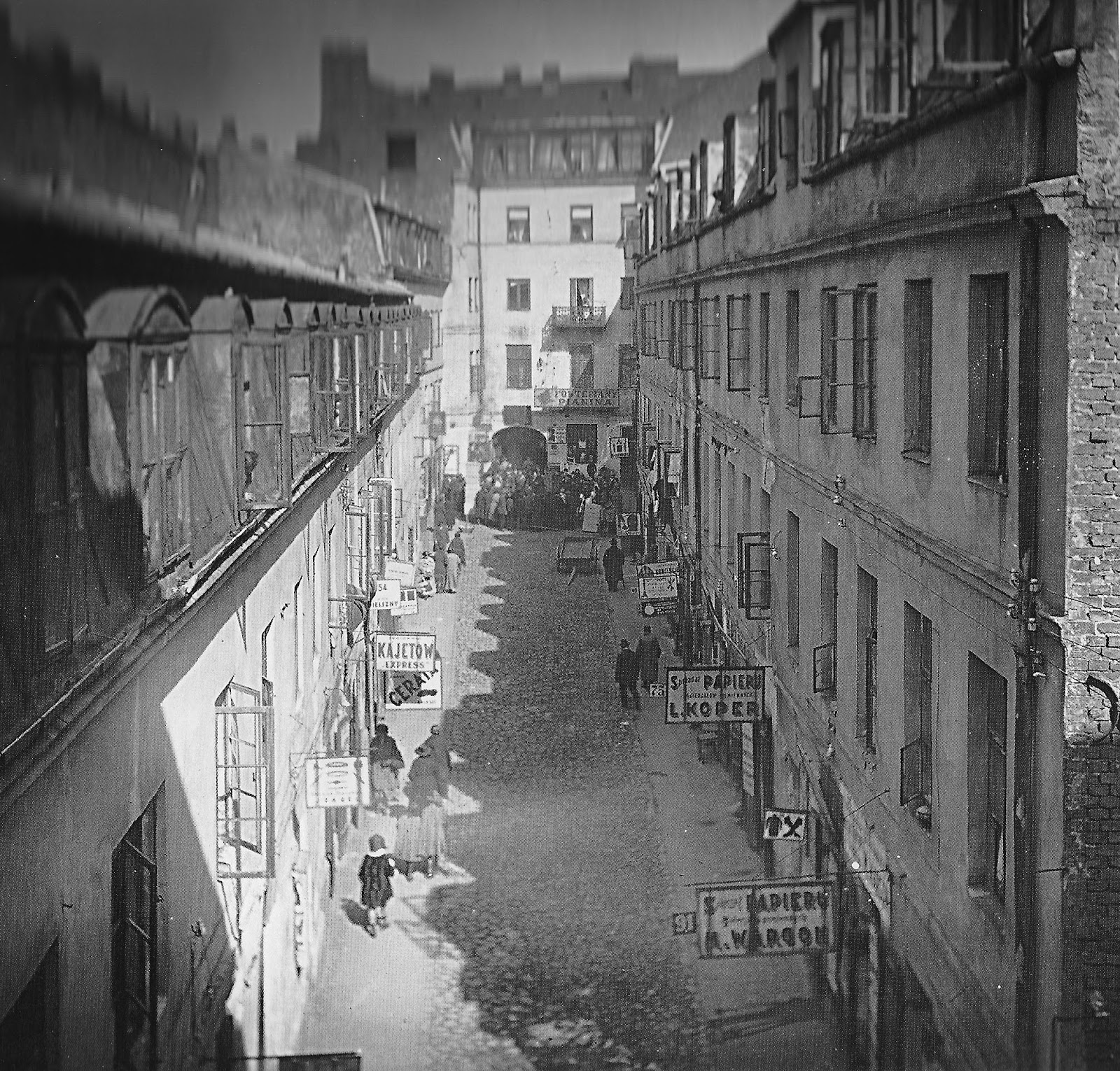
Alley-courtyard, Warsaw, 1920's

The Museum's street evocation
            A very tall corridor-like passage evokes a street in a Jewish neighborhood in a city: it reminds me of a photo of one such alley in Warsaw, though it’s actually based the prewar Zamenhofa Street, by the present museum (and a strategic place during the Warsaw Ghetto uprising); the museum street has real cobblestones.  But the light is eerie and gray, with indistinct figures projected at the end of  street, which leads into the very graphic, jagged and angular spaces of the Holocaust.Poland was particularly gruesome at this time, since all the major death camps were located within its borders.  The black ceilings seem lower here and low lighting adds to a sense of claustrophobia. I’ve been to many other Holocaust museums and Auschwitz too, but coming to it from the rest of this museum world, it is particularly poignant. 


            The postwar galleries are sort of anticlimactic, since there are very few Jews in Poland now, but having this big museum in Poland is at last a tribute to what was.  Though it’s gone, there’s a fascination there now to find this culture and treasure it s remnants by the Poles themselves.  When I was there, there were not only foreign tourists (including a bunch of elderly Israelis with their Hebrew-speaking guide), but large numbers of local visitors and groups of school children.  Maybe some day real Jews might even come back.

            One postscript: the realization that up to about a century ago, women were just as repressed here as they were in most places at that time.  During the time it functioned, I would have been banned from the glorious Gwozdiec prayer hall; women had to sit upstairs in a narrow space relegated to them, where they could enjoy the view through a four-inch slit cut into the wall that excluded them.
Thomas Hubka's reconstructed view of the women's section in Resplendent Synagogue


            And another Postscript: Hitler was rumored to have actually planned his own Jewish Museum in Prague: “The Museum of an Extinct Race,” displaying confiscated Jewish artifacts from destroyed synagogues and private homes, first from Bohemia and Moravia, later from all over Europe, as evidence of the total destruction he was carrying out (it did involve the survival and preservation of many of these objects). POLIN represents a dignified and thorough tribute to what Hitler wiped out, but affirms that Jews are hardly extinct!  Ha!

____________________________________________________________
For a brief article on the diverse nature of museums see The Encyclopedia Britannica Online.

For much more information, virtual visits and links for the Museum of the History of Polish Jews:

The two best books on wooden Synagogues are: 

Maria and Kazimierz Piechotka, Heaven's Gates. Wooden Synagogues in the Territories of the Former Polish-Lithuanian Commonwealth, Krupski I S-KA, Krakow, 2003

Thomas  C. Hubka, Resplendent Synagogue.  Architecture and Worship in an eighteenth Century Polish Community, University Press of New England, Hanover, 2003. 

For a briefer treatment of wooden synagogues and links online see: 


For the ceiling reconstruction for the museum, see  http://www.handshouse.org/a-brief-history-of-polish-synagogues/  AND

For the world of Aragonese Mudéjar churches: http://www.aragonmudejar.com


Friday, May 20, 2016

Tech Revolution of the Mid 1400’s Part Deux; Bart the Red

That Gorgeous Debutante: Saint Engracia (Boston, Gardner Museum)
I wish I could write novels, because the life and career of the 15th century painter Bartolomé de Cárdenas, a.k.a. Bartolomé el Bermejo (Bart the Red) would make a terrific one.  He had an amazing talent, was able to completely master the extremely difficult and subtle craft of oil glaze painting developed in Flanders. Even more amazing, was able to adapt it to the demands of his home country, Spain—or more exactly the Kingdom of Aragon without losing its integrity.  Others who tried, like Lluís Dalmau, simply didn’t have the ability to do so, or like that amazing Sicilian master Antonello de Messina, subsumed it into local aesthetic demands, Helping to launch something quite new..

Engracia Tortured: Bilbao Museum of Fine Arts
Bart had to take a technique suited to small-scale paintings evoking more precious objects of gold and jewels into billboard size altarpieces of many components, keeping a comic-book-like sequence of visible episodes readable while not sacrificing the illusion of detail.  He did this like no one else.  Big pictures of formally posed iconic saints like the gorgeous Saint Engracia (what! you’ve never heard of her?) are combined with smaller stories of her life, like her torture by being whipped, though she never removes her hat, in a very melodramatic situation, and everything works aesthetically as well as dramatically.

Someone this good, even as an artisan-class craftsperson, should have been able earn a tidy fortune and live really well, but Bart turns out to have been his own worst enemy.  He wasn’t a murdering psychopath like Caravaggio, but perhaps more of a sociopathic hippie: in an age when the painting business was contract driven and the patron could make the demands, he was definitely idiosyncratic.

Contracts for altarpieces were generally legalistically routine.  Dimensions and components would be specified, along with subject matter, a due date and a payment schedule.  Payments were usually one third down (which allowed the painter to buy his materials), one third at a midpoint, most commonly when the big wooden panels were prepared and the compositions were drawn in ready to paint, and the last at completion and installation.  We have only one contract for Bart, and it is definitely not typical.  The usual dimensions, subjects, etc. are mentioned, and also a specification that oil be the medium, but then come a series of clauses that speak to the behavior of the painter: there was a second painter in the contract, Juan de Boniella whose role seemed to be as Bart’s monitor.

Juan had to manage expenditures, and more importantly, keep a record of the days that Bart actually worked, and the days he “wandered away.”  The painting had to be done in Daroca, where the altarpiece was destined for a local church, and if Bart left it incomplete or skipped town, he was to be excommunicated.  This last provision sounds drastic, but it was common practice at the time.  The contract writers did make one mistake though.  The second payment was when the big center image of the altarpiece (in this case, Saint Dominic of Silos) was complete and installed on the altar, and the remaining eleven panels were to be finished for final payment.
Saint Dominic of Silos (Prado) - The Part Bart Really did


Bart finished the big image (it’s now in the Prado Museum), but then he skipped town and was duly excommunicated.  He wasn’t a local to begin with.  He was probably born in the south of Spain, (Cordoba), if a later frame inscription is true.  But he was first working in Valencia, in 1468.  Six years later he was in Daroca, and the next he was heard of was in Zaragoza in 1477, where he worked with another painter Martín Bernat, who became his guarantor, finished the altarpiece (or at least Martin seems to have done a lot of the labor), and got “recommunicated.”

Rube
Where he was in the intervening three years is anybody’s guess (though there’s one speculation that he went back to Valencia to do the Virgin of Montserrat (see Part I), but he abandoned the subordinate parts of that too.  “wandering away,” as mentioned in the contract sort of evokes someone going AWOL—I keep thinking of the early 20th century baseball player, Rube Waddell, an incredible pitcher, but given to leave a game in progress to chase a passing fire engine.   We don’t know how long Bart spent in Daroca either, but did some other work there for a converso merchant, Juan de   He also married a widow, Gracia de Palaciano, who was also part of Daroca’s converso community.  It’s interesting that both Loperuelo and Gracia were called before the newly-established Inquisition later in the century, and both paid fines, Gracia also performing some form of penance.
Loperuelo—once more religious paintings for this New Christian.

Bart was probably Christian, but if he moved in Loperuelo’s circle, he was probably hanging out not only with conversos, but also Jews and Muslims (Loperuelo was accused of being too friendly with both).  At any rate Bart apparently never went back to Daroca, though his wife may have remained there, since she is mentioned in a document there concerning the property of her first husband in 1481.

Meanwhile, Bart worked with Bernat in Zaragoza, collaborating with him on at least one other altarpiece.  It was probably an expedient relationship, with Bernat giving him professional legitimacy, and as Bernat’s own paintings show, this fellow seems to have borrowed a lot from Bart in compositions.  This might sound like an intellectual property issue now, but in the 15th century, sameness was considered good, and many craftsmen did it.  But no matter, Bernat never got the hang of Bart’s subtleties.

One other indication of our painter’s character comes in another clause of a contract to paint some alabaster sculpture in the biggest altarpiece in Zaragoza cathedral that head been damaged in a fire.  Bart was one of a group of local painters who worked on this project, but not only was he paid more than the others, but he insisted on having his own painting space, that he could lock up when not in use, and nobody was to observe him at work.  His specialized technique must have been a well-guarded commodity.

It seemed as if Bart eventually either got bored in Zaragoza too; as an inland city, it was probably less interesting than Valencia, where he was before, and Barcelona, where he was working by 1486.  Here again, he started another altarpiece that he probably didn’t finish (and it was destroyed during the Spanish Civil War in 1936, so there’s no way of knowing for sure).
 
The Pietà (Barcelona Cathedral), Best Possible Image
He did have the fortune of meeting a wise and enlightened Canon of Barcelona Cathedral, Lluís Desplà, and for his personal chapel, Bart painted his masterpiece, as fabulous as the Virgin of Montserrat, but unlike Francesco della Chiesa, Desplà got a completed work.  And what a work!  It’s after Jesus was taken down from the cross, and he lies on his lamenting mother’s lap.  On one side was Desplà’s favorite saint, the erudite Jerome, on the other kneels Desplà himself.  This is a guy who has been out here a long time: he has more than a 5 o’clock shadow and circles under his eyes, suggesting extended meditation on the Crucifixion tragedy.  Like the Virgin of Montserrat, there is an amazing landscape, both more subdued and subtle:  there’s a rainstorm to the left, a rainbow over a distant mountain range with one snow-capped summit in the middle, and a city under a sunset sky to the right.  Flowers, butterflies and little lizards are everywhere, so integrated into the landscape that you really have to look for them.


This painting never reproduces well: you have to see it and meditate on it for awhile, just like Desplà probably did.  It’s now in the Barcelona Cathedral museum, so any visitor can do this.  When Bart was on his game, there was no one like him.  The problem was that he was still flaky.  Unsurprisingly, he never made it into the city’s painting establishment as far as can be seen, and the last notices we have are of him designing stained-glass windows in 1500.

Bartolomé de Càrdenas stands out from a conventional occupation within a conventional world.  Even the fact that he had a nickname (El Bermejo—the Red:  lots of painters in Italy at the time had nickname as did everyone else, but it’s very uncommon in Spain.  Was he a redhead?  Was his complexion ruddy? Did he get angry and rage a lot?

Christ in Limbo: Ugly Nudes (Barcelona, Museu Nacional d'art de Catalunya
When he really devoted himself to his art and craft, he was unique.  He painted the ugliest nude figures in art history: hairy and round-shouldered, including Jesus himself.  Most of them look like merchants and workers that he might have encountered in a local bathhouse.  Few of them look   His virgin saints are lovely (except when being tortured).  But it’s those spectacular landscapes that have all the poetry.  He took the oil glaze medium to its limits for its time and the figural conventions that bounded that period’s imagination.
happy, either.

If anybody wants to write the novel, contact me.  I’ll give you all the background, and the spaces between the documented facts leave lots of room for juicy inventions.

I have been fascinated with Bartolomé “el Bermejo” for most of my professional life, ever since I saw a really bad photo of the Pietà as an undergraduate.  I did both my dissertation and a book on him, and I still have an article about him in press.
My book is; Bartolomé de Cárdenas “el Bermejo,” Itinerant Painter in the Crown of Aragon, Bethesda, International Scholars Publications, 1996.

But there has been so much more found about him since then, though most of it has been published in Spanish.  I wrote the Wikipedia article on him, and recently updated it, so there’s a good deal of citations in the footnotes for up-to-date research.  The Wikipedia link is: https://en.wikipedia.org/wiki/Bartolomé_Bermejo

For Rube Waddell, see: http://baseballhall.org/hof/waddell-rube 

Wednesday, May 18, 2016

The Tech Revolution of the 1400’s; Masters Bartolomé, Lluís and Zanetto

Bartolomé de Cárdenas, a.k.a. Bartolomé Bermejo: Virgin of Montserrat, Acqui Terme Cathedral

She’s young and gorgeous, dressed in rich royal robes with brocade and ermine, and even wears a crown.  Her kid, maybe a year old, sits in the buff on her lap.  It could be a royal portrait from a long time ago but it’s not, really.  Not only do both of them have rays coming from their heads, but her chair is a really jagged carpenter’s two-handed saw.  She doesn’t mind, and the merchant kneeling by her side doesn’t think anything is out of line.  Behind and around them is the most amazing landscape, with cliffs and monasteries, and a long grassy vista leading to the shore, on which distant boats are anchored.  It’s sunrise, and the clouds reflect the red and yellow of the sun, still below the horizon.

All of this glamor has a religious subtext. After all, it’s over 500 years old, and most of the European pictures we have from that time—or at least those that we know about now, are religious paintings—many of them showing Christianity’s favorite girl, the Virgin Mary, and the infant Jesus.  Nothing strange here, except that nature seems to have equal billing.  The saw refers to a mountain in Catalonia called Montserrat (sawed up mountain)—a sacred spot with a miracle-working medieval image of the Virgin, and this play on words would have particularly resonated with the merchant.  His name was Francesco della Chiesa (Francis of the Church), and he was an Italian from a town named Acqui Terme, working in his firm’s branch office in Valencia.  He ordered this piece, along with two attached folding wings with other images, for his hometown church.

This was a time when painters and paintings were not the self-driven, gallery-traded artists as they are viewed today.  In the 1480’s, and for centuries before this and a century or two after, at least in Europe, painting was a craft, and generally paintings were made-to-order, whether as religious offerings for churches, or myth and romance-driven interior decoration for houses.  In either case, paintings were viewed as somewhat down-scale; if you were really rich, you would have ordered your picture in enameled metal, precious metal, alabaster or marble for churches, or for residences as well as places of worship, richly-colored tapestries or embroidery, this last often with the addition or pearls, beads or even jewels. In imitation of the more precious things, paintings were brightly colored.  In the case of religious ones, thin, very thin sheets of gold leaf would stand in for the real thing, and the paintings done on wood, in egg tempera and other binding media where necessary, to last awhile.  Most of the domestic ones were done on cloth, and like so much like interior decorator art now, not meant to outlast current décor.

The 15th century had seen a technical revolution, particularly in the area of Flanders in Northern Europe, in which the traditional binding medium, egg yolk, which acted as the binding medium for painting on wood, was replaced by oil, usually linseed, but occasionally walnut.  Tempera, the egg-yolk medium, produced very durable, quick-drying color (thinking of washing egg off a breakfast plate if you’ve left it for a few days).  The oils permitted slower drying, blending on the painting surface, and much greater depth and richness because of their greater transparency, and often required many coats of glazing to achieve this.  During the first half of the century, Flemish master painters such as Jan van Eyck, Robert Campin and Roger van der Weyden began to push the possibilities of this new medium, and developed techniques that produced the most amazing simulations of all sorts of textures and atmospheric gradations, making the simulation of gold and jewels something that could nearly rival the real thing.

Jan van Eyck, Virgin of Canon George van der Paele, Bruges, Groninge Museum, Bruges
All this was produced by a long and laborious process, which involved the mixing of dried processed   In the case of that anal-retentive superstar, Jan van Eyck, this could involve tiny brushes of just a few hairs in some fine details and certainly also magnifying glasses.
minerals, vegetable and even animal colors, some of them extremely toxic, with the oil medium, after grinding the pigment lumps into a power of varying fineness, and then applying these colors layer by layer.

As Master Eyck produced his miracles, these paintings, many of which were as small as jeweled relics as well as big ones, he became an international superstar, a prestigious painter to the local Duke, Philip the Good of Burgundy, with orders from rich Italians and other magnates and merchants, domestic and foreign.  He became so famous that even after his death, the name “Master Johannes” became synonymous with the best of Flemish production throughout the continent.

It isn’t surprising that Flanders had an early monopoly on the technique, and few foreign practitioners really got the hang of how to do it well for the next half-century.  Actually, you had to go to Flanders to learn it properly for a long training period, and even if you understood its principles, you might not have the talent to exploit it properly. 

Lluís Dalmau, The Virgin of the Councilors, Barcelona, Museo Nacional d'Art de Catalunya
Dalmau: Saint Baudel
Here are two examples of foreign wannabe oilmasters, both with connections that gave them an advantage: The first is a Spanish painter, who enjoyed the title of City Painter in Valencia, named Lluís Dalmau.  He also enjoyed the favor of his King, Alfonso “the Magnanimous” of Aragon, who sent him to Bruges in Flanders (home of Jan van Eyck) in 1431.  He stayed there, apparently in the   But soon after, Alfonso took on an official court painter, and it wasn’t Dalmau, but rather another local, Jaume Baço Jacomart, whom he would abandon in turn after he conquered Naples.  Nothing at all is known about Dalmau’s work for the King, the city of Valencia or anybody else, until 1443, when, in Barcelona, he took on a municipal commission to paint an altarpiece for the City Hall chapel that featured the Virgin and Child, plus two other saints of relevance to the council, and the five councilors of the year 1443.  The Virgin of the Councilors is a sort of reprise of Jan van Eyck’s Virgin of Canon van der Paele with quotes from the über famous Ghent Altarpiece, that he would have seen a decade earlier, but nowhere as good, even though it is done with oil medium.  Somehow it turns out as a sort of Eyck paint-by-numbers from a ten-year old pattern.  And the only other paintings known to be by Dalmau, without the advantage of Eyck’s prototype, are more traditional, and certainly less exploitive of the possibilities of oil glazes.  This is Saint Baudel, painted in a very traditionally Catalan way, encased in gold-leaf brocade; handsome, but flat, except maybe in his face.
Eyck studio for a number of years, coming back to Valencia to decorate a pavilion for his king six years later.
 
Zanetto Bugatto, Galeazzo Sforza, Milan, Castello Sforzesco
Weyden, Anthony, "Great Bastard of Burgundy"

The second is an Italian named Zanetto Bugatto, court painter to the ducal Sforza family of Milan.  He was sent to Roger van der Weyden’s studio by Bianca Maria Visconti, wife of Francesco Sforza between 1460 and 1463, and later became the official portraitist of their son and successor, Galeazzo Maria Sforza.  As a court painter and designer, he was responsible for many tasks, of which painting portraits was just a part, including medallions with the Duke’s “official” image.  Only a few painted fragments are linked with him with any security, one being a portrait of Galeazzo Maria, and the fragment of an altarpiece with his plump wife Bona and a patron saint.  I haven’t seen a

pigment/medium analysis of either one, and both have been tampered with a lot over the centuries,
Zanetto: Bona and her Patron Saint, Milan, Museum of Applied Arts
but both pictures show whatever painting technique he had was modified very much according to the demands of Milanese conventions and tastes, though he seems to have been a better painter than Dalmau.. The Flemish development of the ¾ portrait was rejected by his patron for the more traditional Italian profile view, also echoed in the portrait medallions of stone and gold for which he provided designs.

Both of these cases show that local traditions and tastes both win over the precious and detailed Flemish oil glaze products: foreign buyers may have collected imported works from the likes of Eyck and van der Weyden, but they preferred more familiar adaptation by their home-grown painters; in any case, neither Dalmau nor Bugatto approached those northern paragons in what they could do with their newly acquired skills.

One of the very few who pulled it off was the guy responsible for painting the wonderful Virgin of Montserrat (or at least her metaphor), made around 1480.  He was a master painter named Bartolomé de Cárdenas, originally, it seems, from Córdoba in southern Spain, but by 1468 practicing his trade in Valencia.  He must have spent some time in a Flemish studio (my own inclination was with Roger van der Weyden), but there was no aristocratic sponsor in his case.  In part deux of this tale, I’ll describe Bartolomé’s singular painting skills and eccentric career and lifestyle.  Just to give you a clue, after painting the wonderful main painting of the Virgin of Montserrat, he walked from the rest of the commission, and the side paintings, which he may have sketched out, had to be finished by someone else.
Bartolomé de Cardenas and Rodrigo the Osona, the entire Virgin of Montserrat Triptych


___________________________________________________

For Zanetto Bugatto, there's an article by Luke Syson, entitled "Zanetto Bugatto, Court Portraitist of Sforza Milan" in the Burlington Magazine, May 1996, pp. 300-308.  If you have Jstore access, you can access it at:http://www.jstor.org/stable/886901?seq=1#page_scan_tab_contents

Material on Lluís Dalmau is harder to find in English: A brief comment on the Virgin of the Councilors is available from the website of the Museu Nacional d'Art de Catalunya: http://www.museunacional.cat/en/9-lluis-dalmau-virgin-consellers-1443-1445

For Master Bartolomé de Cárdenas, a.k.a. Bartolomé Bermejo, wait for part deux.